
Stuttering Resource BUNDLE | SLP Resource
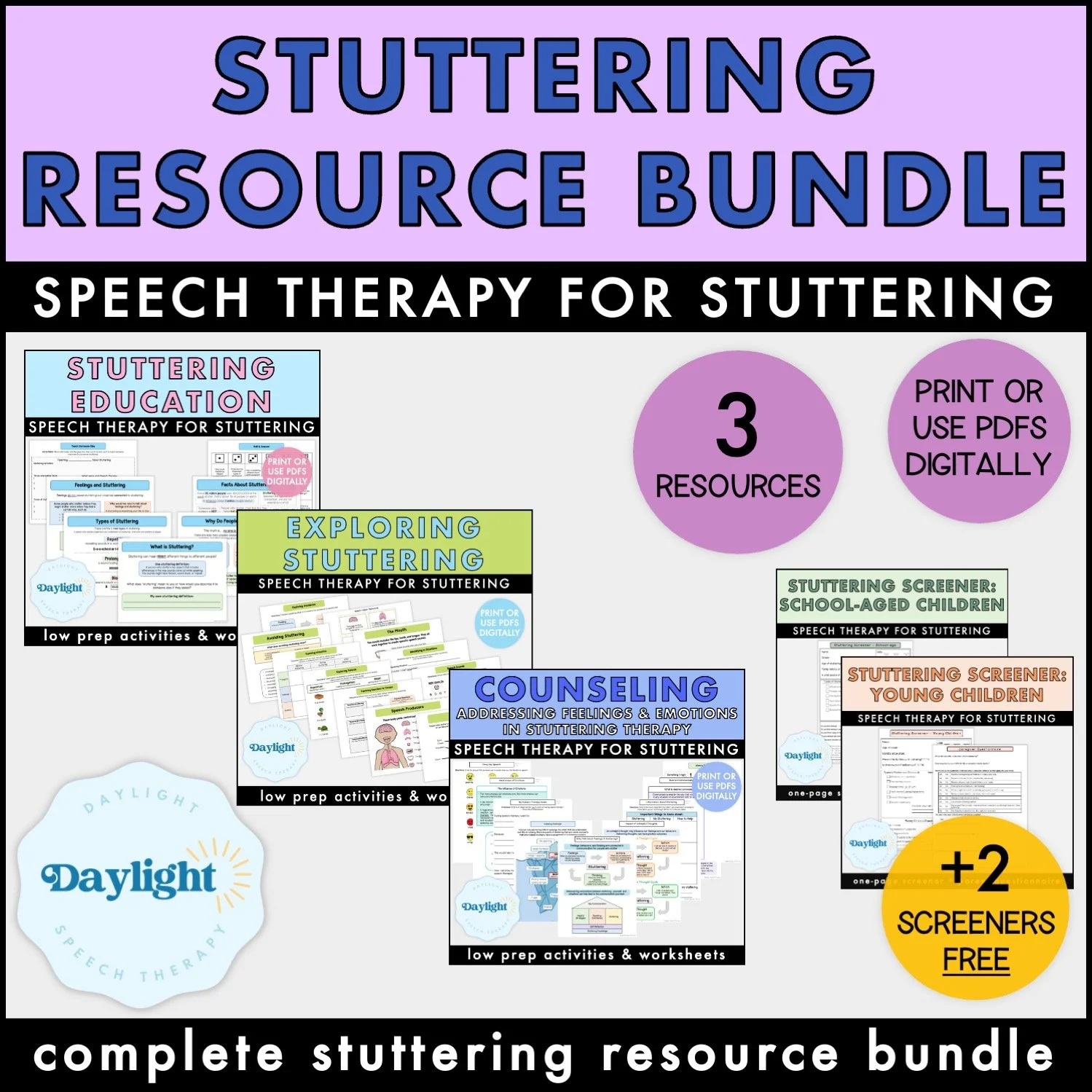
Get the Stuttering Education, Exploring Stuttering, and Counseling resource materials in ONE bundle PLUS one-page stuttering screeners for young children and school-age children included for FREE!
Details for each resource listed below:
Stuttering Education Resource:
Use this resource in your treatment plan to teach an individual who stutters about stuttering and fluency disorders. This resource will provide a comprehensive and necessary foundational knowledge to begin addressing stuttering in speech therapy. It can be printed (perfect for lamination for continued use!). This resource can also easily be used digitally and cohesively with annotation features for telehealth sessions.
This resource includes the following targets for addressing stuttering education:
General stuttering information
Types of stuttering and other behaviors
Facts about stuttering
Thoughts and feelings about stuttering
Self-reflection activities
Basic advocacy activities
Knowledge games
Pre & post-quiz
Visual models to represent stuttering treatment
Homework templates for student
How it works:
Addresses foundational knowledge, beginning with the basics and transitioning to more complex aspects of stuttering, such as feelings/attitudes. The resource was designed to be delivered over a period of time, as each topic may take several weeks to comprehend/put in to practice. This resource is designed to be hands-on so that the individual who stutters is just as involved as the therapist.
Exploring Stuttering Resource:
Use this resource to teach an individual how to explore their own stuttering and tension, as well as avoidance/escape (secondary characteristics) in their speech with 50 pages of information/activities. Exploration of stuttering is a crucial step before implementing speech management strategies and to become more comfortable with the natural flow of stuttering. This resource will aid treatment and discussions, with explicit instructions for the implementation of activities. It can be printed to use with an individual or it is perfect for laminating for continued use! In addition, it can be cohesively used with annotation features during telehealth sessions.
This resource includes the following targets for addressing stuttering:
Specific tips for the SLP for implementation
Why exploring stuttering is necessary
Speech Producers (pictures and activities)
Defining stuttering and non-stuttering speech
Types of stuttering and secondary characteristics
Types of avoidances
Exploring avoidances
Exploring and identifying tension
Exploring reactions to stuttering
Pages of prompts and conversation starters
How it works:
Specific instructions are included for activities. Activities are leveled, to begin with speech helpers, discuss behaviors, and identify behaviors during speech.
Counseling Activities Resource:
Use this resource with school-age children and teenagers to address negative feelings and attitudes associated with stuttering. This resource contains approximately 90 PAGES of activities that can be used more than once for various discussion topics. It will aide your counseling practice and discussions throughout treatment, with explicit instructions for implementation of activities. It can be printed to use with an individual or it is perfect for laminating for continued use! In addition, it can be cohesively used with annotation features during telehealth sessions. This resource is also intended to TEACH the SLP with 22 pages of SLP tips about counseling with individuals who stutter. Contains varying age-appropriate activities for school aged children.
This resource includes the following targets for addressing stuttering:
LOW PREP: all specific handouts/activities are print and go (but we recommend SLP’s read through instructions before implementation!)
SLP instructions for all activities
Feeling definitions related to stuttering
Various Activities:
Exploring emotions associated with stuttering
Emotional learning
Addressing stuttering experiences
Discussion maps for talking about stuttering feelings
Writing and scale tasks to address feelings
Thought/action/feeling analysis
Helpful thinking and thought re-framing
Addressing hiding stuttering/avoidance
Problem-solving
Social scenarios
Reflection exercises
Personal goal development
Home Reflection Activities
How it works:
Specific instructions are included for activities with age recommendations. Activities are scaffolded/leveled to begin addressing attitudes and feelings, beginning with basic discussions and ending with more complex discussions.
One-Page Screeners for Young Children and School-age Children Who Stutter: {FREE in bundle}
These are quick one-page screenings that can be completed via observation! It is intended to aid a speech-language pathologist with a criterion screener of speech fluency for BOTH young children and school-age children who stutter and determine if further evaluation or treatment is necessary. It includes a parent questionnaire in order to obtain important information from caregivers for further quick assessment of overall fluency.
Screeners include:
One-page screener (Addressing feelings/attitudes/avoidances)
Caregiver Questionnaire
Get the Stuttering Education, Exploring Stuttering, and Counseling resource materials in ONE bundle PLUS one-page stuttering screeners for young children and school-age children included for FREE!
Details for each resource listed below:
Stuttering Education Resource:
Use this resource in your treatment plan to teach an individual who stutters about stuttering and fluency disorders. This resource will provide a comprehensive and necessary foundational knowledge to begin addressing stuttering in speech therapy. It can be printed (perfect for lamination for continued use!). This resource can also easily be used digitally and cohesively with annotation features for telehealth sessions.
This resource includes the following targets for addressing stuttering education:
General stuttering information
Types of stuttering and other behaviors
Facts about stuttering
Thoughts and feelings about stuttering
Self-reflection activities
Basic advocacy activities
Knowledge games
Pre & post-quiz
Visual models to represent stuttering treatment
Homework templates for student
How it works:
Addresses foundational knowledge, beginning with the basics and transitioning to more complex aspects of stuttering, such as feelings/attitudes. The resource was designed to be delivered over a period of time, as each topic may take several weeks to comprehend/put in to practice. This resource is designed to be hands-on so that the individual who stutters is just as involved as the therapist.
Exploring Stuttering Resource:
Use this resource to teach an individual how to explore their own stuttering and tension, as well as avoidance/escape (secondary characteristics) in their speech with 50 pages of information/activities. Exploration of stuttering is a crucial step before implementing speech management strategies and to become more comfortable with the natural flow of stuttering. This resource will aid treatment and discussions, with explicit instructions for the implementation of activities. It can be printed to use with an individual or it is perfect for laminating for continued use! In addition, it can be cohesively used with annotation features during telehealth sessions.
This resource includes the following targets for addressing stuttering:
Specific tips for the SLP for implementation
Why exploring stuttering is necessary
Speech Producers (pictures and activities)
Defining stuttering and non-stuttering speech
Types of stuttering and secondary characteristics
Types of avoidances
Exploring avoidances
Exploring and identifying tension
Exploring reactions to stuttering
Pages of prompts and conversation starters
How it works:
Specific instructions are included for activities. Activities are leveled, to begin with speech helpers, discuss behaviors, and identify behaviors during speech.
Counseling Activities Resource:
Use this resource with school-age children and teenagers to address negative feelings and attitudes associated with stuttering. This resource contains approximately 90 PAGES of activities that can be used more than once for various discussion topics. It will aide your counseling practice and discussions throughout treatment, with explicit instructions for implementation of activities. It can be printed to use with an individual or it is perfect for laminating for continued use! In addition, it can be cohesively used with annotation features during telehealth sessions. This resource is also intended to TEACH the SLP with 22 pages of SLP tips about counseling with individuals who stutter. Contains varying age-appropriate activities for school aged children.
This resource includes the following targets for addressing stuttering:
LOW PREP: all specific handouts/activities are print and go (but we recommend SLP’s read through instructions before implementation!)
SLP instructions for all activities
Feeling definitions related to stuttering
Various Activities:
Exploring emotions associated with stuttering
Emotional learning
Addressing stuttering experiences
Discussion maps for talking about stuttering feelings
Writing and scale tasks to address feelings
Thought/action/feeling analysis
Helpful thinking and thought re-framing
Addressing hiding stuttering/avoidance
Problem-solving
Social scenarios
Reflection exercises
Personal goal development
Home Reflection Activities
How it works:
Specific instructions are included for activities with age recommendations. Activities are scaffolded/leveled to begin addressing attitudes and feelings, beginning with basic discussions and ending with more complex discussions.
One-Page Screeners for Young Children and School-age Children Who Stutter: {FREE in bundle}
These are quick one-page screenings that can be completed via observation! It is intended to aid a speech-language pathologist with a criterion screener of speech fluency for BOTH young children and school-age children who stutter and determine if further evaluation or treatment is necessary. It includes a parent questionnaire in order to obtain important information from caregivers for further quick assessment of overall fluency.
Screeners include:
One-page screener (Addressing feelings/attitudes/avoidances)
Caregiver Questionnaire
Individual Use License
This resource is licensed for individual use only. Purchase grants a single user the right to use this material for their own clinical, educational, or personal practice. Sharing, distributing, reproducing, reselling, or posting this resource (in whole or in part) in any form—digital or print—is strictly prohibited without written permission from the author.
For group, clinic, school, or multiple-user licensing, please contact Daylight Stuttering & Speech Therapy for group pricing.